The great river
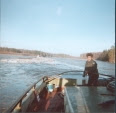
The night was dark and soft and it was easy to feel the moisture in the air due to the vicinity of the great river. I sat on ground in the grass and other of the two ordinary seamen, Leo, was sitting beside me. The third one of us - the second ordinary seaman stood little apart. He was a man with heavy bulk and I heard his name uttered, it sounded like Aki, or something like that, I at once found him be sullen and he has been cutting his hair off and had shaving his head so that everyone could seen his head shining in the sunlight like polished a egg. As Aki was red and robust, Leo was tiny and slim.
We all were sitting or standing waiting for our captain.
There was the boatmen’s hut and our captain had entering into it I was told that he was going to deal with the boatmen the drive, up to the ship..
I felt tired and was sitting double folded and there was pain in my stomach for been sitting so long time in that cramped plane, eleven long hours in that full loaded tube unable to move anywhere but toilet.
During those eleven hours flay there have been dramatically change in the environment, having been no more than twenty hours ago white winter around us and the temperature in Helsinki 15 c below the zero. Upon arriving at the Mississippi the temperature showed 20degrees of C above the zero and I still wore my fur-winter boots.
Sitting there in green I was truck by the odour of the earth and hay and the moisture of open water, all those things after ice blocked sea and the frozen nature sterilized by the winter.
The door of the hut opened and in the lighted doorway was seen a silhouette of a man, It was tall slim figure of our captain in his khaki uniform accompanied by a boatman. I got on my feet and we started down to river, the boatman goes ahead and then our captain, we followed them in a single file and got into boat.
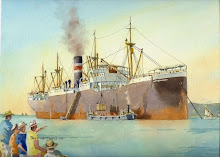
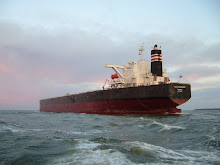
The ship was there anchored somewhere on middle of the wide river of the large river. The water looked black and there were sparks of the reflections of the lights on surface of the water. The boat drove into night and got rounded the lofty aft of the ship the aft structure dowering up like an lighted cathedral, then the huge black ship’s side ran past and then there was the gangway in sight been lowered down near the water. The boat stopped and everybody of us stood up to stand-by to leap on gangway. The captain went first and then we limped one by one after him.
Tuesday, 9 March 2010
Tuesday, 26 January 2010
ओं american
On Americam shore
the sirens were hailin
It was a lovely day in the Coos Bay; the air transparent and bright likes a crystal. By the night it went off and then there was the bad weather with rain and wind. It lasted all the night and the next day along. The weather seemed changed. No matter since we were washing the super structure of amidships using strong caustic soda mixed with brown soap and by aid of the heavy rain.
In the evening I got washed my clothes, too.
The good weather was back on Wednesday.
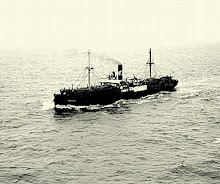
Regulus was a ship as a tramp of the ocean with her capacity of nearly seven thousand tons. She was called as a Canadian’s liberty by her sheer lines and was flaying Panamian flag and owned by some company of the refugee of Estonian. The interior of the sailors’ quarter was Spartan, the bulkheads being build of a naked iron and there was not a proper heater to be warm the cabins. The wages were in the lowest English tariff. I have been said up myself and I wanted paid-off in the Coos Bay on the last day of December.
There is a saying among the seafarers: ‘When the shore people have their regular fest as the midnight summer, or the feast of the New Year, at same time every year, the sailors will have their holiday and feast every time when they are going to sign on board a ship and when they are signing off the ship.
I was signing off with an ordinary seaman named Sven.
We remained aboard till the next morning, which was Tuesday, and when the sun rose we were well shaved and well attired and we said good-bye to our shipmates and friends aboard. Then we landed along the gangway carrying our gears on our shoulders.
There we were, on the shore of America, two young sunburned sailors, I was nineteen, and Sven was twenty. Been service for six months at the Ocean trade I had hundred and twenty dollars in my pocket. We felt free and relieved and relaxed thought there was a faint feeling of sad to leave our watery home once again. With our money we went spending the wholly afternoon watching the shop fronts and shopping around. I bought a new hat and Sven wanted have the wholly new silk khaki uniform. There were many strange things advertised but we couldn’t afford all them.
Looking no more backward we set off on foot to the Raymond Lodge. The road ran along the Pacific shore then through nice woodland, over the green hillocks. That new setting was welcoming alternation to hour eyes since we were so long accustomed to see the bare watery world round the ship. A first the walking was wonderful, to walking along the road on the steady soil.
It was afternoon of the next day when we arrived in the Gold Beach and was walking to Raymond Lodge where we picked up n a room. The room was costly, four dollars was pretty much money for couple hour of doze, but the modern convenience of the room was worth of it. As the Pistol River was distance of thirteen miles from Gold Beach, we kept moving after the short break and walked five of it.
Then there was long lift to the Brookfield, past the Ceresin City. The redwood looked good. It was really something.
the sirens were hailin
It was a lovely day in the Coos Bay; the air transparent and bright likes a crystal. By the night it went off and then there was the bad weather with rain and wind. It lasted all the night and the next day along. The weather seemed changed. No matter since we were washing the super structure of amidships using strong caustic soda mixed with brown soap and by aid of the heavy rain.
In the evening I got washed my clothes, too.
The good weather was back on Wednesday.
Regulus was a ship as a tramp of the ocean with her capacity of nearly seven thousand tons. She was called as a Canadian’s liberty by her sheer lines and was flaying Panamian flag and owned by some company of the refugee of Estonian. The interior of the sailors’ quarter was Spartan, the bulkheads being build of a naked iron and there was not a proper heater to be warm the cabins. The wages were in the lowest English tariff. I have been said up myself and I wanted paid-off in the Coos Bay on the last day of December.
There is a saying among the seafarers: ‘When the shore people have their regular fest as the midnight summer, or the feast of the New Year, at same time every year, the sailors will have their holiday and feast every time when they are going to sign on board a ship and when they are signing off the ship.
I was signing off with an ordinary seaman named Sven.
We remained aboard till the next morning, which was Tuesday, and when the sun rose we were well shaved and well attired and we said good-bye to our shipmates and friends aboard. Then we landed along the gangway carrying our gears on our shoulders.
There we were, on the shore of America, two young sunburned sailors, I was nineteen, and Sven was twenty. Been service for six months at the Ocean trade I had hundred and twenty dollars in my pocket. We felt free and relieved and relaxed thought there was a faint feeling of sad to leave our watery home once again. With our money we went spending the wholly afternoon watching the shop fronts and shopping around. I bought a new hat and Sven wanted have the wholly new silk khaki uniform. There were many strange things advertised but we couldn’t afford all them.
Looking no more backward we set off on foot to the Raymond Lodge. The road ran along the Pacific shore then through nice woodland, over the green hillocks. That new setting was welcoming alternation to hour eyes since we were so long accustomed to see the bare watery world round the ship. A first the walking was wonderful, to walking along the road on the steady soil.
It was afternoon of the next day when we arrived in the Gold Beach and was walking to Raymond Lodge where we picked up n a room. The room was costly, four dollars was pretty much money for couple hour of doze, but the modern convenience of the room was worth of it. As the Pistol River was distance of thirteen miles from Gold Beach, we kept moving after the short break and walked five of it.
Then there was long lift to the Brookfield, past the Ceresin City. The redwood looked good. It was really something.
Saturday, 16 January 2010
BIT OF THE PAST
I am rather unpolished than educated man, thought widely read since I have had plenty of time to read.
I had followed the sea when I was at age of ten, by taking part in the fishing at sea and learn to row the boat under the strict command of those fishermen, I very early became know how tasted the hard work and how the callus grew in my palms. Hard it was, and the hardness was as everyday life in those days on that coastal region, it prepared me to the hardship. Almost every young lads on that waterfront were waiting the right age to come when he could have the passport and is allowed go to sea.The sea was not only the great highway out to the world, it was also the means- addition earn the money -also get out see to the word since in that time there was very little other way to travel widely. When I was filled sixteen years I joined to merchant service, signing on my fist foreign going ship as a galley boy. At last my desire was realized.
I have faced the dangers of the sea and shore which have been part of my life and heritage of seamen as well as the spell of beach-comber when there were not a ship to sign on.
The nowadays seaman cannot learn to be seaman in the old sense, because there is not the ships and the ship's company where to be learn the seamanship and he cannot keep himself physically fit because there is not the work to do.
When sailor was off paid and they stepped on shore with their money, they were soon surrounded by landcharks, male and females.
THE SIREN WERE HAILING
I sat on my bunk and listened. What was this all about? When I unlocked the door, pushed it ajar, and peeped into darkness I saw two human figures standing near by the rail. The scene was illuminated by a weak lamp on the bulkhead making the bulwark lustrous with the wet skin of iron. Beyond the bulwark, there was the vast emptiness of the dark sea, from where the sound of the waves and the moan of the wind could be heard. One of these men wore an old military blouse and a woollen hat was pulled over his head. Another character, next to the first one has nothing but bunch of hair on his head, the man dtood half-faced to the light; he seemed to be a lean, lightly dressed black man and was close to an ash-dumper that was attached to the bulwark.
The yellow wedge of light from the door cut across the darkness and hit the two men standing by rail; white eyeballs flashed and the white sweatband stood out with a clear stripe against the black skin of the N. I shut the door. I didn’t know what the time was and I lay down half-awake on the bunk. Later, how much later I have no knowledge. I was awakened by a loud banging on the door and there was a voice crying outside: “Wake up! Wake up! It’s six o’clock! Wake up, you!”
It was quarter-past six as I staggered into the mess room in which I found Rissa: she was sitting at the end of the table with a cup of coffee in front of her, smoking a cigarette. She was a large woman with dark hair; there was shadow on her upper lip as a fair moustache. When she spoke there was deep alto in her tone. She could have been about age of thirty or less; the strong eyebrows and thick dark hair gave her a stern expression; by all accounts she appeared to have a strong character. When she saw my entering, she glanced at me.
“I was told that you have locked the cabin’s door. Is it true?” she asked.
“Who told you?”
“The watch told me that the door was locked,” she said.
I nodded.
“You don’t keep the door locked at sea. Shore people locked their doors, but not seamen on the open sea. If something happens, you will be locked in there and will go down with the ship. Try to remember it. Now you must bring the coffee up to the bridge.”
At half-past six, under the direction of Rissa, I collected cups upon the tray; the moody minded and faced cook chucked two buns on tray and a full can of black coffee, then thrust it into my hand. Holding the tray in balance, I set out and started for the bridge, climbing up the ladder that led up to it; the way was steep and slippery. Step by step I rose; the higher I got, the more the ship was rolling. Each step asked for hard labour and all the time the ship rolled and plunged, while single-handedly I struggled up. It was hard work, but finally I managed ending up on the bridge and stood in front of closed sliding door of the wheelhouse. The chief mate, wearing a long fur coat, plucked the door open. I held the tra out with straight hands unable to move.
“What the hell you are up to? Take it in all the way there. Right away there.” At the same moment the ship swung and I plunged into the wheel-house, thrown by the impetuous inclination of the ship, and without reducing my speed I crossed the floor of the wheelhouse and was hurled into the navigation cabin. Then, under the ship’s reverse movement, I could stop and laid the tray on the chart table. As I slowly returned cross the wheelhouse, I had time to notice the steering wheel on my left side, and behind it, was, standing on the low platform, the seaman I had seen the previous night, talking with the black man on deck. Later I heard him called as Metros.
With greedy eyes I looked about the environment. The wheelhouse was panelled in teak and there was a brass binnacle near the front window. On my right hand stood the well-polished telegram machine; behind the row of numerous windows was a great view of the extensive sea. I went out to the wing of the bridge and stayed for a moment to look. It was good stage to view around; there was an almost unhampered panorama over the ship and far out over the sea. Leaning over the windbreaker I could see the whole forepart of the ship clearly in the grey light of the sky above the mast. Rolling slowly, the mast head made a gentle arc against the sky.
The general colour of the sea was grey, so was the sky above. I was struck by this infinite expanse around me. The ship rolled slowly from left to right and back again; the standing rigging and all the fixed wires and ropes rose diagonally up and were affixed to the mast under the black cross tree. Looking backward, I could see how the stern rose and fell at even intervals and the wake was visible with two white lines of foam behind the ship.
Through the cold grey sea the ship proceeded and the undulating wake behind it was as straight as an arrow. We were heading before the wind; followed by the grey waves that lifted their manes in the same direction. The black smoke of burning coal was drifting with the wind and was lowering down in troughs. It was quiet; the greatest noise in this environment was the sound of the raising and falling waves and the hiss of the bow wave. Aloft from the rigging I could hear slow hum of breeze.
I am rather unpolished than educated man, thought widely read since I have had plenty of time to read.
I had followed the sea when I was at age of ten, by taking part in the fishing at sea and learn to row the boat under the strict command of those fishermen, I very early became know how tasted the hard work and how the callus grew in my palms. Hard it was, and the hardness was as everyday life in those days on that coastal region, it prepared me to the hardship. Almost every young lads on that waterfront were waiting the right age to come when he could have the passport and is allowed go to sea.The sea was not only the great highway out to the world, it was also the means- addition earn the money -also get out see to the word since in that time there was very little other way to travel widely. When I was filled sixteen years I joined to merchant service, signing on my fist foreign going ship as a galley boy. At last my desire was realized.
I have faced the dangers of the sea and shore which have been part of my life and heritage of seamen as well as the spell of beach-comber when there were not a ship to sign on.
The nowadays seaman cannot learn to be seaman in the old sense, because there is not the ships and the ship's company where to be learn the seamanship and he cannot keep himself physically fit because there is not the work to do.
When sailor was off paid and they stepped on shore with their money, they were soon surrounded by landcharks, male and females.
THE SIREN WERE HAILING
I sat on my bunk and listened. What was this all about? When I unlocked the door, pushed it ajar, and peeped into darkness I saw two human figures standing near by the rail. The scene was illuminated by a weak lamp on the bulkhead making the bulwark lustrous with the wet skin of iron. Beyond the bulwark, there was the vast emptiness of the dark sea, from where the sound of the waves and the moan of the wind could be heard. One of these men wore an old military blouse and a woollen hat was pulled over his head. Another character, next to the first one has nothing but bunch of hair on his head, the man dtood half-faced to the light; he seemed to be a lean, lightly dressed black man and was close to an ash-dumper that was attached to the bulwark.
The yellow wedge of light from the door cut across the darkness and hit the two men standing by rail; white eyeballs flashed and the white sweatband stood out with a clear stripe against the black skin of the N. I shut the door. I didn’t know what the time was and I lay down half-awake on the bunk. Later, how much later I have no knowledge. I was awakened by a loud banging on the door and there was a voice crying outside: “Wake up! Wake up! It’s six o’clock! Wake up, you!”
It was quarter-past six as I staggered into the mess room in which I found Rissa: she was sitting at the end of the table with a cup of coffee in front of her, smoking a cigarette. She was a large woman with dark hair; there was shadow on her upper lip as a fair moustache. When she spoke there was deep alto in her tone. She could have been about age of thirty or less; the strong eyebrows and thick dark hair gave her a stern expression; by all accounts she appeared to have a strong character. When she saw my entering, she glanced at me.
“I was told that you have locked the cabin’s door. Is it true?” she asked.
“Who told you?”
“The watch told me that the door was locked,” she said.
I nodded.
“You don’t keep the door locked at sea. Shore people locked their doors, but not seamen on the open sea. If something happens, you will be locked in there and will go down with the ship. Try to remember it. Now you must bring the coffee up to the bridge.”
At half-past six, under the direction of Rissa, I collected cups upon the tray; the moody minded and faced cook chucked two buns on tray and a full can of black coffee, then thrust it into my hand. Holding the tray in balance, I set out and started for the bridge, climbing up the ladder that led up to it; the way was steep and slippery. Step by step I rose; the higher I got, the more the ship was rolling. Each step asked for hard labour and all the time the ship rolled and plunged, while single-handedly I struggled up. It was hard work, but finally I managed ending up on the bridge and stood in front of closed sliding door of the wheelhouse. The chief mate, wearing a long fur coat, plucked the door open. I held the tra out with straight hands unable to move.
“What the hell you are up to? Take it in all the way there. Right away there.” At the same moment the ship swung and I plunged into the wheel-house, thrown by the impetuous inclination of the ship, and without reducing my speed I crossed the floor of the wheelhouse and was hurled into the navigation cabin. Then, under the ship’s reverse movement, I could stop and laid the tray on the chart table. As I slowly returned cross the wheelhouse, I had time to notice the steering wheel on my left side, and behind it, was, standing on the low platform, the seaman I had seen the previous night, talking with the black man on deck. Later I heard him called as Metros.
With greedy eyes I looked about the environment. The wheelhouse was panelled in teak and there was a brass binnacle near the front window. On my right hand stood the well-polished telegram machine; behind the row of numerous windows was a great view of the extensive sea. I went out to the wing of the bridge and stayed for a moment to look. It was good stage to view around; there was an almost unhampered panorama over the ship and far out over the sea. Leaning over the windbreaker I could see the whole forepart of the ship clearly in the grey light of the sky above the mast. Rolling slowly, the mast head made a gentle arc against the sky.
The general colour of the sea was grey, so was the sky above. I was struck by this infinite expanse around me. The ship rolled slowly from left to right and back again; the standing rigging and all the fixed wires and ropes rose diagonally up and were affixed to the mast under the black cross tree. Looking backward, I could see how the stern rose and fell at even intervals and the wake was visible with two white lines of foam behind the ship.
Through the cold grey sea the ship proceeded and the undulating wake behind it was as straight as an arrow. We were heading before the wind; followed by the grey waves that lifted their manes in the same direction. The black smoke of burning coal was drifting with the wind and was lowering down in troughs. It was quiet; the greatest noise in this environment was the sound of the raising and falling waves and the hiss of the bow wave. Aloft from the rigging I could hear slow hum of breeze.
Monday, 18 February 2008
An announcement
All this writing there exist as they are without the proofreading and final correction

Saturday, 22 December 2007
Friday, 21 December 2007
Chrismas at sea
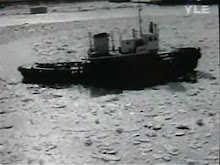
There is a small maritime museum in a small coastal town named Rauma, in Finland The museum still keep up the memories of that sombre Christmas eve in 1947 when the American ship named Park Victory went down off the south west coast of Finland taken ten crew members with her into wateri grave of the Baltick Sea.
In this museum you could find the dismal story of Park Victoria telling with those small remains and debris of that ill- fated ship.
On 9 of December in 1947 the liberty ship Park Victoria was arriving at Hampton Road to be load cargo as coal charity for Europe. Getting the loading completed, she 11th December left Hampton Road and sailed out to Atlantic bound for Finland. Captain Allen Luis Zeppin the master of the Park Victory hardly had any exact knowledge about that remote country in a far corner of the northeast Europe.
The ship had the crew of 43 aboard, all told, and after been crossed the pool she arrived at the northern Baltic Sea in the afternoon of Christmas Eve just before as the grey winter day of sixty latitude turned into darkness.
The ship was bound for Turku, a city that located on the mainland, seen from the sea, beyond a hundred of rocky isles. By five o’clock at afternoon the Park Victory was calling out the pilot from the Uto, the utmost lighthouse post of the southwest archipelago. When the pilot was boarding there was a new order for the new destination being now Helsinki. Mr, N. Linström, the pilot in duty suggested to the captain to anchor the ship off the island to be wait there the next morning and then continued the voyage to Helsinki, the daylight allowing better navigation with good visibility, for the region between the lighthouse Uto and the Helsinki, was still partly unclean of the mines, and there was just a narrow passage which need the daylight to be find.
The pilot remains aboard and the starboard anchor was dropped to the bottom near the rocky islad, not far from the lighthouse. By the night the southwest wind strengthen, the pilot who slept in pilot’s cabin, was wakened with the feeling that the ship was heavily rolling, from which he instantly understood that the anchor has loosened its hold, and the ship was drifting.
It was snowing and the gale was blowing with full strength, the temperature of air was lowered two degrees in minus Celsius.
The watch was turned to and was stand-by on the forecastle head ready to lower the second anchor, but the captain hesitated for the main engine was slowly propelling against the wind and he evidently thought the problem what the two anchors at the same time down could cause. The seas grew biggest and after two ours there was a bang as the ship touch the bottom in a trough . It wasn’t serious touch and there reported not damages. An our later there was more serious hit in the amidships and the ship was grounding. The blow broke the plates of the engine room bottom and the engine room rapidly flooded. To the next the ship suffered black out as the generator went off.
The order was given sent out the distress signal and lowered the boat.
On the Uto, inhabitants consisted of a fishing community about a hundred occupants including the military staff and the pilots.
As there was tradition among the islander to gather together every Christmas Eve in the stone chapel to be cerebrate and singing together, so was also in that particular Christmas Eve in 1947. When the oldest lighthouse keeper was delivered the sermon of the Christmas, and the occasion in this tiny chapel was over, the people returned to their homes without knowing that at the same time there was a ship in distress and the crew of it was struggling for their life in the dismal winter night, not far from the chapel.
Decades after the distress, a fisherman named Tovard Sjöberg, islander by born, and who must have been quite young that time, with accordance the interview in 1997 he still well remembered that very long night:
“When the alarm was given, it was half past three in the morning and everybody rushed towards the pilot station asking of questions to each other; what has happen? Or whether she is still aloft? “
The pilot boat set out to the dark stormy sea following by a small military craft under command of Tovard Sjöberg.
“ We were heading in direction where we assumed the ship been anchored, but there wasn’t anything to be seen but lot of tiny lights, floating on the waves. When we picked up one of them we found it being a life buoy. We criss-crossed the scene hopping to find something else, then we spotted a light from a rock and we steered towards it. We circled the small rock trying to find a place for safety landing but we didn’t found a suitable place get ashore. was too dangerous put right to shore With the gale blowing and the underwater rock surfing in the pitch-dark night, so I decided stay close by the rock and wait the morning to come, and the daylight with it.
With first rays of the dawn we made new attempt to come near the rock. It was little abated and we approached the rock from lee side and succeed got a rope over. There were fifteen men, they were spend all the nigh on that small rock being expose all that time to the winter gale and ice cold water. One of them was passed away by hypothermia. fourteen were alive but in bad condition. We hauled all them in by and by then retuned to Uto. There were many of survivors wore just a underwear and were chilled to the bone
There was another lifeboat of the Park Victory, been beached on another rocky, it was half submerged and it beat itself against the rocky there were sailors there sitting in water unable to climb ashore. In this lifeboat was sitting among the American sailors, the pilot who was boarding the ship a day before.
Among the first survivals was the master of Park Victory, captain Allen Luis. Many of the survivors were in bad condition for there was frost in air, so that I had many times cleared the windscreen of the boat to be able to see something ahead.”
The people of the Uto continued search the region hopping still find more survivors from the wrecked American ship. There was plenty of floating wreckage and debris beached the isle around but not a survivors. A lifeboat reported been found washed up on an islad far a way from the scene with the perished sailors in it.
From the forty-eight crewmembers of the Park Victory, ten were lost in the watery grave of the northern Baltic Sea.
The days after the disaster there could see the tip of masts and the white bridge of the vessel showing through the water in deep about ten feet. During the winter the moving ice lifted the wreck up in sight, and sifted the remnants into more deep and she disappeared forever
The text is so as it is, there lack of the edition.
In this museum you could find the dismal story of Park Victoria telling with those small remains and debris of that ill- fated ship.
On 9 of December in 1947 the liberty ship Park Victoria was arriving at Hampton Road to be load cargo as coal charity for Europe. Getting the loading completed, she 11th December left Hampton Road and sailed out to Atlantic bound for Finland. Captain Allen Luis Zeppin the master of the Park Victory hardly had any exact knowledge about that remote country in a far corner of the northeast Europe.
The ship had the crew of 43 aboard, all told, and after been crossed the pool she arrived at the northern Baltic Sea in the afternoon of Christmas Eve just before as the grey winter day of sixty latitude turned into darkness.
The ship was bound for Turku, a city that located on the mainland, seen from the sea, beyond a hundred of rocky isles. By five o’clock at afternoon the Park Victory was calling out the pilot from the Uto, the utmost lighthouse post of the southwest archipelago. When the pilot was boarding there was a new order for the new destination being now Helsinki. Mr, N. Linström, the pilot in duty suggested to the captain to anchor the ship off the island to be wait there the next morning and then continued the voyage to Helsinki, the daylight allowing better navigation with good visibility, for the region between the lighthouse Uto and the Helsinki, was still partly unclean of the mines, and there was just a narrow passage which need the daylight to be find.
The pilot remains aboard and the starboard anchor was dropped to the bottom near the rocky islad, not far from the lighthouse. By the night the southwest wind strengthen, the pilot who slept in pilot’s cabin, was wakened with the feeling that the ship was heavily rolling, from which he instantly understood that the anchor has loosened its hold, and the ship was drifting.
It was snowing and the gale was blowing with full strength, the temperature of air was lowered two degrees in minus Celsius.
The watch was turned to and was stand-by on the forecastle head ready to lower the second anchor, but the captain hesitated for the main engine was slowly propelling against the wind and he evidently thought the problem what the two anchors at the same time down could cause. The seas grew biggest and after two ours there was a bang as the ship touch the bottom in a trough . It wasn’t serious touch and there reported not damages. An our later there was more serious hit in the amidships and the ship was grounding. The blow broke the plates of the engine room bottom and the engine room rapidly flooded. To the next the ship suffered black out as the generator went off.
The order was given sent out the distress signal and lowered the boat.
On the Uto, inhabitants consisted of a fishing community about a hundred occupants including the military staff and the pilots.
As there was tradition among the islander to gather together every Christmas Eve in the stone chapel to be cerebrate and singing together, so was also in that particular Christmas Eve in 1947. When the oldest lighthouse keeper was delivered the sermon of the Christmas, and the occasion in this tiny chapel was over, the people returned to their homes without knowing that at the same time there was a ship in distress and the crew of it was struggling for their life in the dismal winter night, not far from the chapel.
Decades after the distress, a fisherman named Tovard Sjöberg, islander by born, and who must have been quite young that time, with accordance the interview in 1997 he still well remembered that very long night:
“When the alarm was given, it was half past three in the morning and everybody rushed towards the pilot station asking of questions to each other; what has happen? Or whether she is still aloft? “
The pilot boat set out to the dark stormy sea following by a small military craft under command of Tovard Sjöberg.
“ We were heading in direction where we assumed the ship been anchored, but there wasn’t anything to be seen but lot of tiny lights, floating on the waves. When we picked up one of them we found it being a life buoy. We criss-crossed the scene hopping to find something else, then we spotted a light from a rock and we steered towards it. We circled the small rock trying to find a place for safety landing but we didn’t found a suitable place get ashore. was too dangerous put right to shore With the gale blowing and the underwater rock surfing in the pitch-dark night, so I decided stay close by the rock and wait the morning to come, and the daylight with it.
With first rays of the dawn we made new attempt to come near the rock. It was little abated and we approached the rock from lee side and succeed got a rope over. There were fifteen men, they were spend all the nigh on that small rock being expose all that time to the winter gale and ice cold water. One of them was passed away by hypothermia. fourteen were alive but in bad condition. We hauled all them in by and by then retuned to Uto. There were many of survivors wore just a underwear and were chilled to the bone
There was another lifeboat of the Park Victory, been beached on another rocky, it was half submerged and it beat itself against the rocky there were sailors there sitting in water unable to climb ashore. In this lifeboat was sitting among the American sailors, the pilot who was boarding the ship a day before.
Among the first survivals was the master of Park Victory, captain Allen Luis. Many of the survivors were in bad condition for there was frost in air, so that I had many times cleared the windscreen of the boat to be able to see something ahead.”
The people of the Uto continued search the region hopping still find more survivors from the wrecked American ship. There was plenty of floating wreckage and debris beached the isle around but not a survivors. A lifeboat reported been found washed up on an islad far a way from the scene with the perished sailors in it.
From the forty-eight crewmembers of the Park Victory, ten were lost in the watery grave of the northern Baltic Sea.
The days after the disaster there could see the tip of masts and the white bridge of the vessel showing through the water in deep about ten feet. During the winter the moving ice lifted the wreck up in sight, and sifted the remnants into more deep and she disappeared forever
The text is so as it is, there lack of the edition.
Wednesday, 23 May 2007
The Pumping Home
Dear Mr Tobin
Thank you for your interesting article.
Due to our waiting list of 4 + years for articles awaiting publication, we are unable to accept at the present time.
Our editor did find your story very interesting and well written, and both he and everyone here at Sea Breezes would like to wish you the best of luck in finding a publisher elsewhere.
Many thanks for thinking of us
Thank you for your interesting article.
Due to our waiting list of 4 + years for articles awaiting publication, we are unable to accept at the present time.
Our editor did find your story very interesting and well written, and both he and everyone here at Sea Breezes would like to wish you the best of luck in finding a publisher elsewhere.
Many thanks for thinking of us
Subscribe to:
Posts (Atom)